
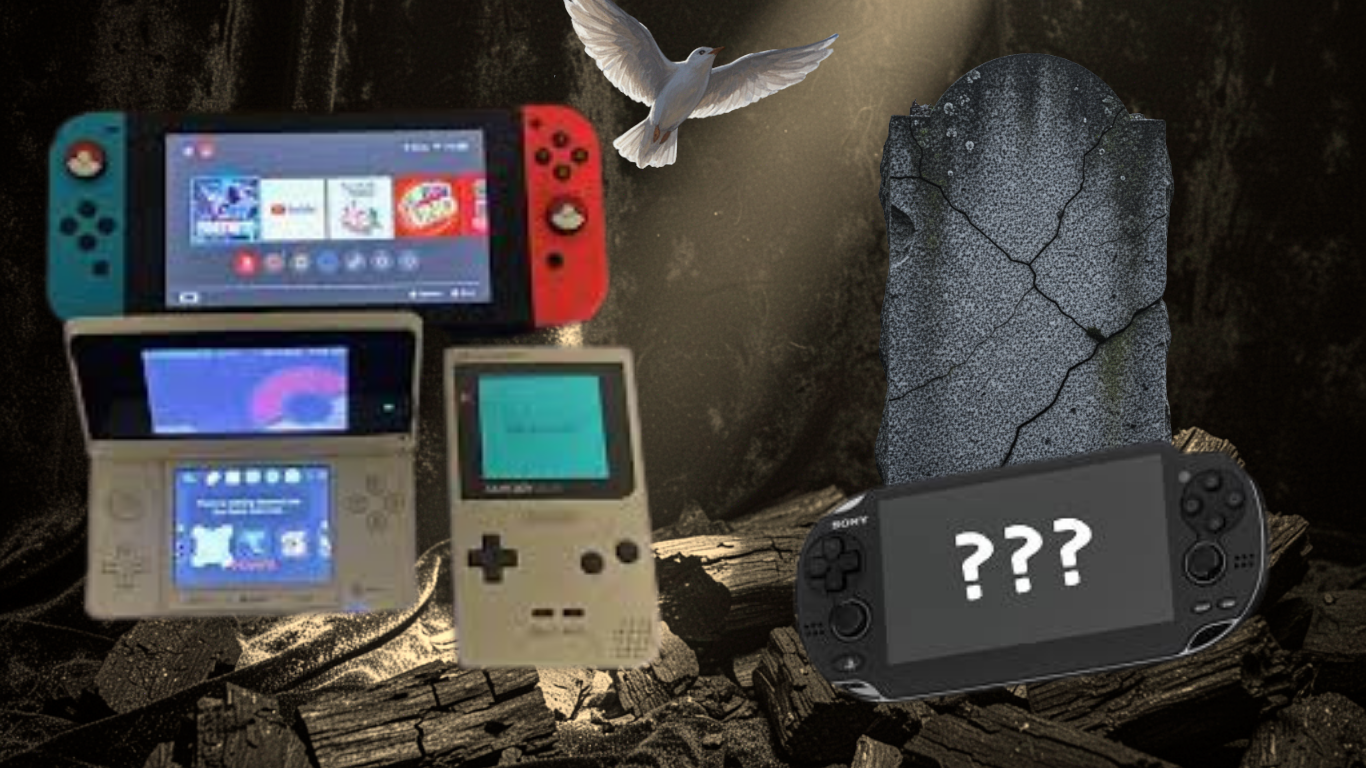
How One Company Controlled Portable Gaming for Decades
When people talk about console wars, they usually mean living room battles — power specs, exclusives, and hardware sales.
But there’s another war that’s been just as fierce.
The handheld war.
And in that fight, one name has consistently stood above the rest:
Nintendo.
For over 30 years, competitors have entered the portable gaming arena.
Almost all of them failed.
The Beginning of Portable Power

The modern handheld era truly began in 1989 with the launch of the Game Boy.
It wasn’t the most powerful device.
It wasn’t in color.
It didn’t look futuristic.
But it had something its competitors didn’t:
- Long battery life
- Affordable price
- Addictive games
And most importantly: Tetris.
The Game Boy went on to sell over 100 million units (including the Game Boy Color), laying the foundation for Nintendo’s portable empire

The First Challengers Fall
In the early 1990s, competitors tried to dethrone Nintendo.
Sega Game Gear
It had color.
It had better graphics.
It also had terrible battery life.
Atari Lynx
More powerful hardware.
Backlit screen.
But bulky, expensive, and short-lived.
Consumers chose practicality over power.
Nintendo survived — again.
The Game Boy Evolution Era
Nintendo didn’t just defend its lead.
It expanded it.
- Game Boy Advance
- Nintendo DS
The Nintendo DS became one of the best-selling gaming systems of all time.
Dual screens.
Touch controls.
Mass-market appeal.
While Sony attempted to challenge Nintendo in the 2000s, the gap remained significant.
Sony Enters the War
In 2004, Sony launched the PlayStation Portable (PSP).
For the first time, Nintendo had a serious technological rival in handheld gaming.
The PSP delivered:
- Console-level graphics
- Multimedia features
- Third-party support
It sold well — over 80 million units globally.
But Nintendo’s Nintendo DS sold even more.
Power wasn’t enough.
The 3DS vs PS Vita: The Final Traditional Battle
The next clash came with:
- Nintendo 3DS
- PlayStation Vita
The PS Vita was technically impressive.
But it lacked:
- Strong first-party support
- Mass-market appeal
- Competitive pricing
Meanwhile, the 3DS recovered from a rocky launch and went on to dominate once again.
After the Vita, Sony exited the dedicated handheld market entirely.
Nintendo remained standing.
The Hybrid Revolution: Switch Changes the War
In 2017, Nintendo changed the definition of handheld gaming with the Nintendo Switch.
It wasn’t just a handheld.
It wasn’t just a home console.
It was both.
This hybrid strategy eliminated the need for separate handheld and home devices — something no competitor has successfully replicated at scale.
The Switch became one of the best-selling consoles ever, extending Nintendo’s portable dominance into a new era.

Why Nintendo Won the Handheld War
1️⃣ Battery Life Over Power
Nintendo prioritized practicality.
2️⃣ Iconic First-Party Games
Pokémon. Mario. Zelda.
Franchises that sell hardware.
3️⃣ Affordable Pricing
Competitors often launched at higher price points.
4️⃣ Broader Audience Appeal
Nintendo targeted kids, families, and casual gamers — not just hardcore players.
5️⃣ Risk-Taking Innovation
Dual screens. 3D without glasses. Hybrid play.
Nintendo experimented without abandoning accessibility.

Did Anyone Truly Compete?
Sony came closest.
The PSP proved there was a market for powerful handhelds. But long-term ecosystem support matters more than specs.
Mobile phones also disrupted handheld gaming in the 2010s, but even that didn’t eliminate Nintendo’s dominance in dedicated devices.
The handheld war didn’t end with a dramatic knockout.
It ended with competitors quietly leaving the battlefield.

The Verdict
In the living room console wars, victories shift generation to generation.
But in handheld gaming?
Nintendo didn’t just win.
It dominated.
From the Game Boy to the Switch, Nintendo defined portable gaming across multiple eras while competitors rose — and fell.
And unless a new challenger emerges with a radically different strategy, the handheld war may remain the most one-sided conflict in gaming history.