
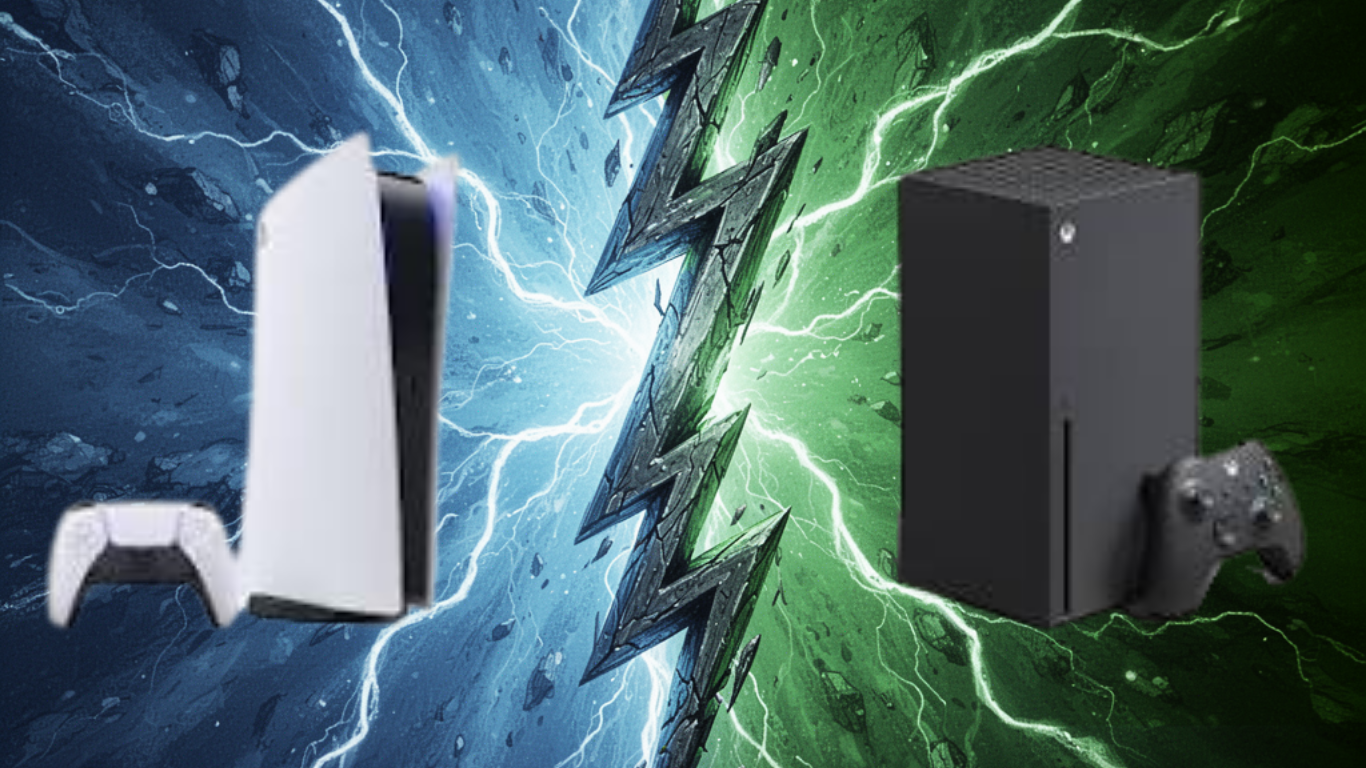
In every console generation, the war begins long before players pick up a controller.
It starts with numbers.
Teraflops. GPU clocks. SSD speeds. Ray tracing cores.
Before the first exclusive drops… before the first sales milestone… the battlefield is already flooded with spec sheets. And at the center of this arms race stand two machines:
- PlayStation 5
- Xbox Series X
Welcome to The Power War — where numbers are weapons, marketing is ammunition, and fans become analysts overnight.

The Battlefield: Teraflops Take the Stage
When the current generation was revealed, one statistic dominated the conversation:
12 teraflops vs 10.28 teraflops.
On paper, the Xbox Series X held the advantage. More raw GPU compute power. Higher theoretical performance ceiling. The green camp declared superiority before launch day even arrived.
Meanwhile, Sony focused on something different:
A custom SSD architecture inside the PlayStation 5 that promised lightning-fast load times and revolutionary game design.
Two different power philosophies:
- Xbox: Maximum raw performance.
- PlayStation: Balanced architecture with ultra-fast storage.
The spec sheet battle was officially underway.

The Weapons: Raw Power vs Smart Engineering
🟢 Xbox’s Strategy: Brute Force
The Xbox Series X was marketed as “the world’s most powerful console.” Higher teraflops. Strong GPU. Consistent native 4K targets.
On paper, the advantage seemed clear.
Microsoft leaned into measurable superiority. Numbers are easy to compare. And in a war fueled by debate threads and YouTube breakdowns, bigger numbers often win arguments
🔵 PlayStation’s Strategy: Speed and Optimization
The PlayStation 5 countered with a different weapon: speed.
Sony emphasized:
- Ultra-fast SSD loading
- Custom I/O architecture
- Developer-friendly tools
Instead of chasing pure GPU dominance, PlayStation built an ecosystem optimized for seamless transitions and immersive worlds.
The message wasn’t “more power.”
It was “power used differently.”
The Reality Check: Do Players Actually Notice?
Here’s where the war becomes complicated.
In real-world comparisons, most multiplatform games perform similarly on both consoles. Frame rates are often near-identical. Resolution differences are sometimes minor.
Digital Foundry videos may dissect pixel counts and shadow quality — but for the average gamer sitting on a couch, the differences are subtle.
The uncomfortable truth?
The Power War is often louder online than it is in your living room.
The Forgotten Combatant: Nintendo’s Different Strategy
While Sony and Microsoft traded teraflops, Nintendo stayed out of the arms race entirely.
The Nintendo Switch is significantly less powerful than both competitors. Yet it thrives — driven by innovation, portability, and iconic exclusives.
Nintendo proves a dangerous point in the Power War:
Raw strength isn’t everything.
Sometimes, creative direction beats technical dominance.
The Psychological War
Specs matter — not just technically, but psychologically.
They influence:
- Early purchase decisions
- Brand perception
- Media narratives
- Fan loyalty
When one console claims “most powerful,” it shapes conversation for years — even if the real-world differences are marginal.
The spec sheet battle isn’t just about performance.
It’s about perception.

Who Wins the Power War?
If we judge purely by numbers, the Xbox Series X holds the teraflop crown.
If we judge by speed and system architecture, the PlayStation 5 delivers innovations that reshape how games are built.
If we judge by market impact?
Power alone doesn’t determine victory.
History shows that exclusive games, ecosystem strength, and brand loyalty often outweigh minor hardware advantages.
The Power War is flashy. It’s loud. It fuels endless debates.
But when the dust settles, players remember experiences — not spec sheets.

Final Verdict: Numbers Don’t End Wars — Games Do
Teraflops may win Twitter arguments.
SSD speeds may impress tech analysts.
But consoles are remembered for the worlds they create.
The war between Microsoft and Sony Interactive Entertainment will continue — with mid-gen refreshes, future upgrades, and next-generation promises.
Yet one lesson remains clear:
Power is only meaningful if it translates into unforgettable games.
And in the grand saga of Console Critics’ Console Wars…
The spec sheet battle is just one front in a much larger conflict.